One Automation Pattern Across Six Industries: A Comparative Study
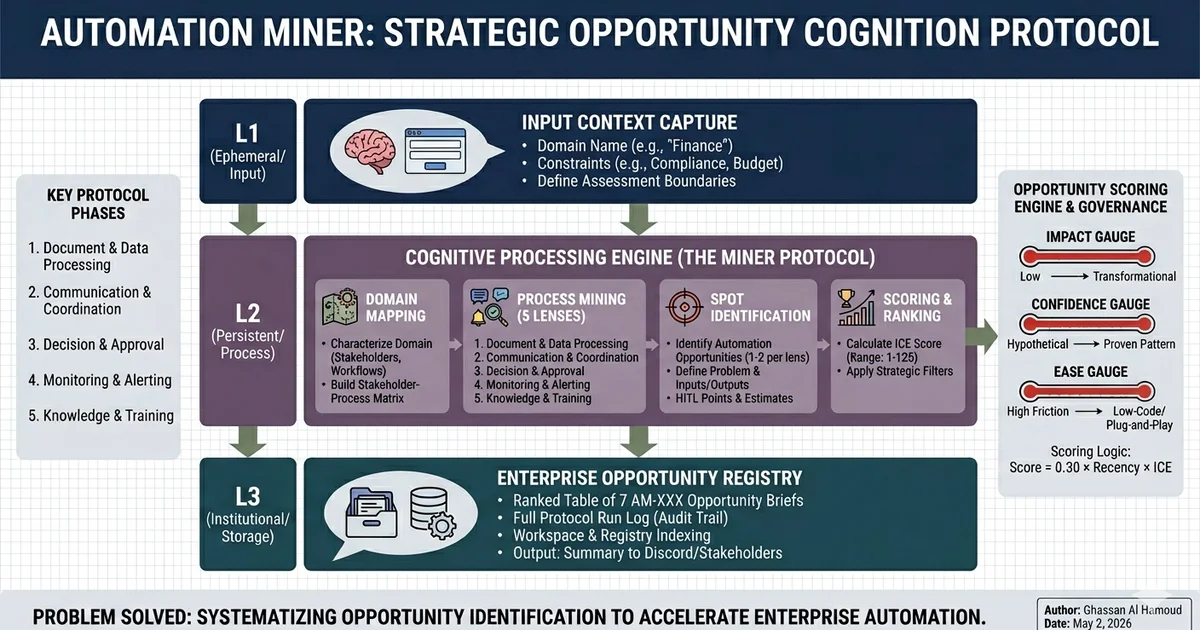
An earlier version claimed the exact same automation pattern appeared across all six industries. The 42-item dataset supports a narrower, more useful conclusion: the top candidates repeatedly transform already-available operational signals into a bounded document, coordination step, or decision—but the inputs, risks, and required authority differ sharply.
The six top-scoring candidates
| Domain | Candidate | Trigger and bottleneck | Available data | Primary risk |
|---|---|---|---|---|
| Healthcare | AU certificate automation | Sickness certification; repetitive document coordination | Patient, dates, codes, required format | Clinical/legal correctness and access |
| Real estate | Lease-document generator | New or changed tenancy; repeated assembly | Party, property, term, clause data | Jurisdiction and clause validity |
| Carrier logistics | Label and manifest automation | Shipment booking; multi-carrier formatting | Order, route, parcel, carrier rules | Misrouting and carrier API drift |
| Precision irrigation | Water-balance scheduler | New sensor/weather interval; manual scheduling | Weather, soil, crop, zone state | Physical harm from bad control |
| Greenhouse | Heating-curve optimizer | Climate deviation; manual set-point tuning | Temperature, humidity, equipment state | Crop and energy impact |
| Wine cellar | Barrel identity and map | Move, inventory, or audit; physical reconciliation | Barrel ID, location, batch, vintage | Traceability and source-data quality |
The repeated structure
trusted trigger
  + accessible source data
  + repeated transformation
  + explicit human/system handoff
  + measurable terminal state
  = candidate for bounded automation
Four of the six domain winners are classified as document work, one as communication, and one as decision work. The evidence therefore does not support “all winners were sensor-to-action loops.” It supports a broader last-mile transformation pattern.
Why last-mile work persists
- Data ownership and workflow ownership differ. The team that stores a record may not own the next action.
- Exceptions dominate design cost. The happy path looks trivial; policy, missing data, and reversals are not.
- Authority is implicit. A human step may encode approval, liability, or professional judgment.
- Monitoring has no action contract. A dashboard exposes state without defining who may change it.
- Benefits and harms accrue to different teams. Local labor savings may create downstream operational risk.
Value and confidence are separate
Expected value comes from frequency, time saved, avoided failure, and improved cycle time. Confidence comes from observed volumes, accessible inputs, stable rules, and evidence that operators actually perform the described work. A high-value hypothesis with weak evidence should enter discovery—not the implementation backlog.
For physical or regulated workflows, start with recommendation or document preparation. Grant actuation authority only after independent verification, safe limits, rollback or compensation, and an accountable owner exist.
Sampling and selection bias
This is a designed comparison, not a representative industry survey. The six domains were selected deliberately. Each run was required to produce seven ideas across five predefined layers. ICE factors were model judgments, and the same prompt structure shaped every result. One historical row also contains an arithmetic inconsistency.
The study can generate hypotheses about recurring workflow shapes. It cannot estimate market prevalence, ROI, or the probability that a random company has the same gap.
How to apply the pattern
- Name one observable trigger—not a broad department.
- Identify the authoritative inputs and their owner.
- Describe the repeated transformation and every exception class.
- Define the terminal invariant and how an independent verifier checks it.
- Record required authority, worst credible harm, and safe fallback.
- Measure current volume, duration, rework, delay, and failure cost.
- Compare the smallest safe automation with leaving the workflow unchanged.